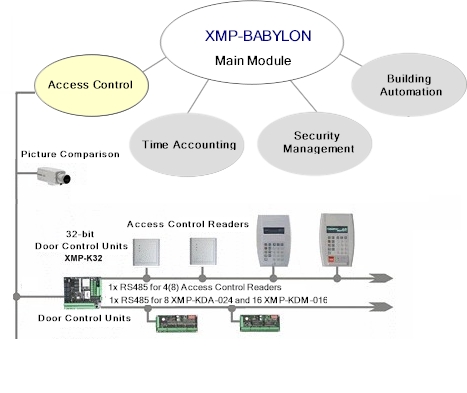
XMP-BABYLON
XMP-BABYLON is a fully configurable high-performance solution for technical and infrastructural facility management.
Characteristics of XMP-BABYLON:
- Developed for Windows 7, 8, 8.1, 2008, 2008R2, 2012, 2012R2
- Multi-user capability and network support via TCP/IP and UDP/IP
- 256-Bit Blowfish- or AES datagram encryption
- Option for additional encryption of connections using TLS V1.2
- Online monitoring of all connected devices
- Up to 2048 Door Control Units with up to 8 Card Readers per system
- Up to 500.000 badges per Door Control Unit (offline)
- Anti-passback feature, valid throughout the system, via direct internal connection
- Elevator control with authorization check for up to 192 floors
- Up to 64 workstations per system
- Up to 64 additional graphical workstations per system
- Up to 66 temporary profiles per cardholder
- Branch software for up to 128 stand-alone XMP-BABYLON systems to exchange e.g. revised data or new log entries
- A redundant XMP-BABYLON system is available as an option, which increases the operational reliability
- 64 open software interfaces enable communication with third-party systems (e.g. SAP® R/3® HR via TCP/IP)
- Integration of monitoring and control functions within the building management system
- Unlimited number of graphics to visualize alarms and processes
- Video log
- Integration of digital video recording systems, e.g. Bosch® VMR, Geutebrück® GeViScope, NiceVision®, Dallmeier electronic®, NETAVIS®, HeiTel®
- Optional user-defined Time Recording and Accounting
- Guard tour patrol system for monitoring e.g. security guards at appointed checkpoints
- Transmission of alarms via e-mail or text message
- Interfaces to key cabinet systems
- Software interface for transmission of XMP-BABYLON alarms to external CCTV systems
- Contamination monitoring in the pharmaceuticals industry to ensure time-limited access restrictions
- Software to export alarm- and event- log entries and cardholder records to a SQL database
- Integration of third-party systems via OPC-Server / OPC-Client
- Workflow
- Integrated SNMP server
- Announcement of visitors using a web interface as an additional option